
Why Systems Thinking Always Beats Motivation
Motivation is unreliable. It rises and falls with energy, emotion, and circumstance. Systems thinking productivity methods create sustainable action that does not depend on how you feel.
This is why people who rely on motivation often feel inconsistent, while people who rely on systems feel steady.
Systems thinking productivity is about designing environments that make progress easier by default.
The Problem With Motivation Based Planning
Motivation based planning assumes that effort is the missing ingredient. When things stop working, the default solution becomes trying harder, pushing through resistance, or searching for renewed inspiration. This approach places the responsibility entirely on the individual rather than on the structure supporting them.
At first, motivation can feel powerful. A new planner, a fresh start, or a burst of energy can create short term momentum. But motivation is emotional and inconsistent by nature. It fluctuates based on sleep, stress, workload, and life circumstances. When planning depends on motivation alone, consistency becomes fragile.
Over time, this leads to predictable outcomes:
The deeper issue is not a lack of discipline. It is that motivation based planning does not account for the realities of modern life. When energy dips or priorities shift, the system collapses. Motivation fades. Systems remain.
What Systems Thinking Actually Means
Systems thinking is the practice of designing structures that support behaviour without requiring constant effort or willpower. Instead of relying on how you feel in the moment, systems create a framework that makes the next step clear.
In planning, systems thinking looks like:
A system does not ask you to feel motivated. It asks you to show up to a structure that already knows what to do. This removes emotional decision making from planning and replaces it with clarity.
Rather than asking yourself what you should be doing, the system answers that question in advance. This is what creates stability and consistency over time.
A system does not require enthusiasm. It requires clarity.
Why Planning Systems Reduce Mental Load
Mental load increases when decisions are repeated daily. When you constantly have to decide what to work on, where something belongs, or what matters most, your cognitive energy drains quickly. This is one of the main reasons people feel overwhelmed even when their task list is not objectively large.
Planning systems reduce this load by answering key questions in advance.
Instead of asking each day:
- What should I work on today?
- Where does this belong?
- What matters most right now?
The system already holds the answers.
When priorities are visible and workflows are defined, your mind no longer has to hold everything at once. The system becomes a trusted external support, allowing you to focus on execution rather than organisation.
This is why planning systems feel calming rather than demanding. They reduce noise. They simplify decisions. They create a sense of control without pressure.
How This Applies to Notion and Life Dashboards
Notion works best when it is used as a system rather than a collection of disconnected pages. Without structure, Notion can quickly become another place where information is scattered rather than organised.
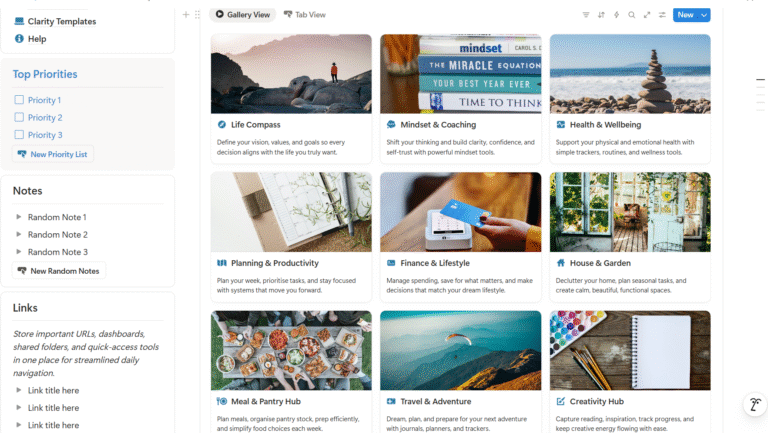
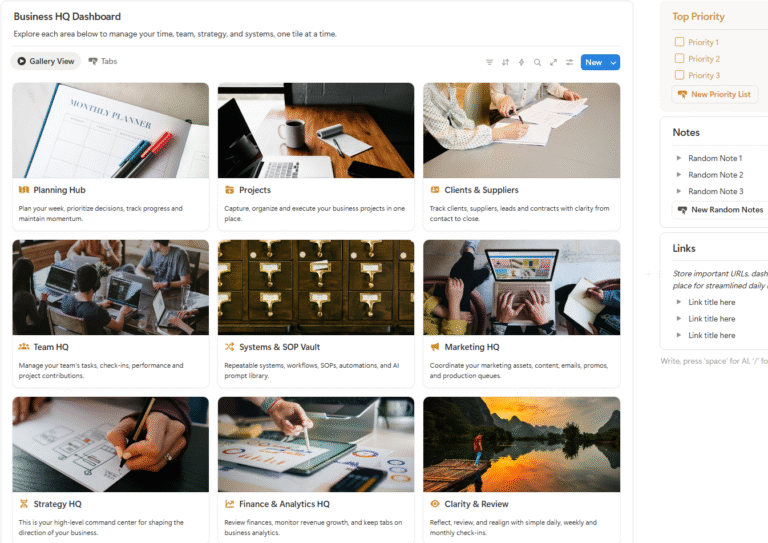
A notion life dashboard is a practical application of systems thinking productivity. It creates one central place for planning, reflection, and action. Instead of jumping between tools, documents, and apps, everything lives inside one coherent framework.
Having somewhere to hold tasks, information, processes, and procedures frees up mental space. When details are captured and organised externally, your mind is no longer burdened with remembering everything. This creates more capacity to think clearly, enjoy free time, and feel genuinely in control of your life.
Planners are not always the right solution either. If you have struggled to use planners consistently or found them too surface level, you may benefit from a system that integrates planning with context. If that resonates, this article explores the idea further:
Most Planners Fail Here’s Why a Notion Planning System Is Better
Systems Create Freedom, Not Rigidity
A common fear is that systems feel restrictive, as though structure will limit flexibility or creativity. In reality, it is chaos that restricts freedom, not structure. When nothing is defined, every decision becomes heavy and every change feels disruptive.
When structure is clear, several important shifts happen.
Flexible systems outperform rigid routines because they adapt to real life. Routines expect consistency regardless of circumstances. Systems are designed to adjust when life changes.
Freedom does not come from having no structure. It comes from having a structure that works with you rather than against you.
Building Systems That Last
Sustainable systems share a few key qualities. They are not built for perfection. They are built for longevity.
Sustainable systems are simple. They focus on what matters most and avoid unnecessary complexity. When systems become too complicated, they stop being used.
They are adaptable. Life changes, priorities shift, and energy fluctuates. A lasting system can adjust without collapsing or needing to be rebuilt.
They reflect real life. Sustainable systems acknowledge imperfect days, competing responsibilities, and changing seasons. They do not assume ideal conditions.
They support change. As goals evolve, the system evolves too. Growth is supported rather than resisted.
Whether you build your own or use a ready built solution like the SYLO Dashboard, the goal is the same. Create a structure that holds you steady when motivation disappears. If you are curious to explore a fully built system, you may want to look at the Sort Your Life Out Dashboard.
Final Thoughts
Motivation is a spark. Systems are the engine.
When productivity depends on feeling inspired, it eventually fails. When productivity is built into your environment, progress becomes consistent.
Systems thinking is not about control. It is about clarity.