
Using Notion as a Central Hub for AI Agents and Automated Workflows
AI tools are advancing quickly, and many people are now experimenting with AI agents to handle research, drafting, task execution, and automation. While these tools promise efficiency, they also introduce a new challenge. Without structure, AI increases speed but not clarity.
This is where using Notion as a central hub for AI agents becomes essential.
Notion does not need to be the place where AI performs tasks. Instead, it works best as the system that holds direction, context, and oversight. When AI agents operate inside a clear structure, they support decision making rather than creating more complexity.
Using Notion for AI agents is not about automation for its own sake. It is about building a system that keeps humans in control while AI handles execution.
Why AI Without Structure Creates Overwhelm
AI agents are excellent at generating output. They can write, research, summarise, and complete tasks quickly. What they do not do well on their own is prioritise effectively, understand long term goals, or evaluate whether something should be done at all.
Without a central system, AI driven workflows often lead to:
Tasks completed without strategic alignment
Outputs disconnected from broader goals
Information fragmented across tools
Increased mental load from managing automation
This is not a limitation of AI. It is a limitation of system design.
AI productivity systems require a central point of reference. This is where Notion fits naturally.
What It Means to Use Notion as a Central Hub
A central hub is not where all work happens. It is where work is coordinated, reviewed, and understood.
When Notion is used as a hub for AI agents, it becomes:
The source of truth for priorities and goals
The place where AI tasks are defined and tracked
A review environment for AI generated outputs
A documentation layer for workflows and processes
This allows AI to operate efficiently while humans retain clarity and oversight. Instead of reacting to automation, you direct it.
How Notion Supports AI Workflow Management
Notion excels at holding structured information, which makes it ideal for managing AI workflows.
A Notion based AI system may include:
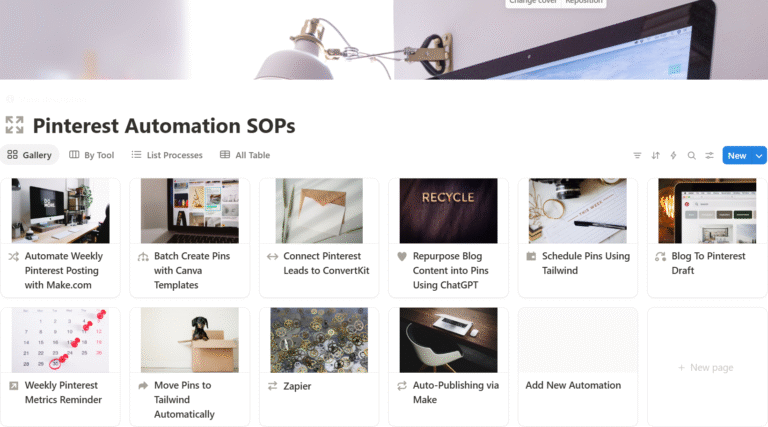
A database of AI prompts and tasks
Clear ownership of which agent handles each function
Status tracking for automated processes
Review queues for human approval and refinement
By keeping this information visible and organised, Notion reduces the friction that often comes with automation. You are no longer guessing what AI is doing or why. The system shows you.
This is digital systems thinking applied to AI.
Separating Human Thinking From AI Execution
One of the most effective ways to use Notion for AI agents is to clearly separate responsibilities.
Humans remain responsible for direction, priorities, and decision making. AI agents handle execution, drafting, and repetitive work.
In practice, this means:
Humans define goals and standards
AI completes defined tasks
Outputs return to Notion for review
Decisions remain intentional and contextual
Notion acts as the interface between intent and execution. This separation prevents over reliance on automation and keeps productivity grounded.
Why Centralisation Matters More Than Automation
Many AI setups focus on automation first. Tools are connected quickly without designing the system that holds them together. This often results in fragmented workflows, poor visibility, and loss of control.
Centralisation solves this problem.
When Notion is the central hub, automation becomes purposeful. You can see how AI tasks connect to projects, priorities, and outcomes. This visibility allows AI productivity systems to scale without becoming chaotic.
Centralisation also makes it easier to pause, review, and adjust workflows as needs evolve.
Dashboards as Control Panels for AI Systems
Dashboards play a critical role in AI driven systems because they provide clarity without micromanagement.
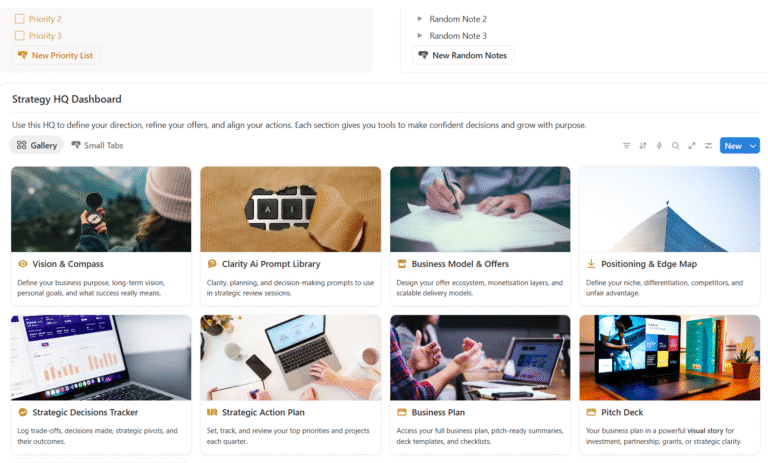
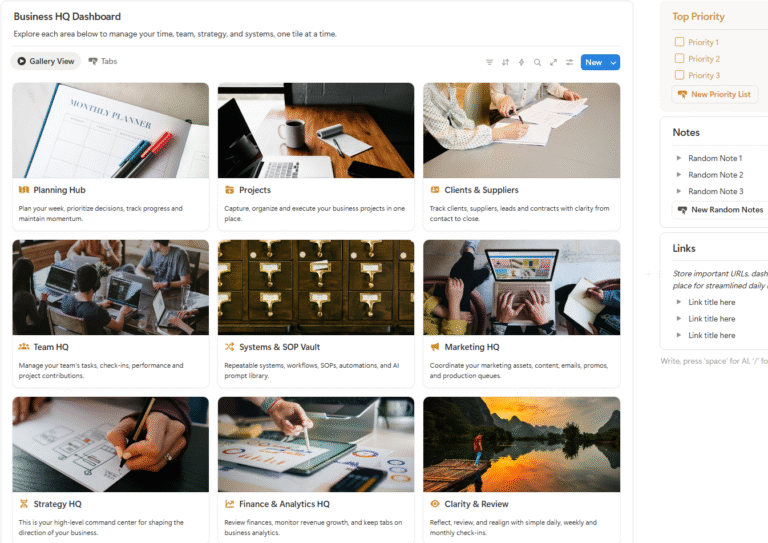
A Notion dashboard used as an AI control panel might include:
Active projects and objectives
Linked AI driven tasks
Pending reviews or approvals
Workflow status indicators
This keeps humans in the loop while allowing AI to handle execution efficiently.
For a foundational understanding of dashboards as systems, see:
Notion Life Dashboard What It Is and Why It Works
Why Notion Reduces Tool Sprawl
As AI tools multiply, tool sprawl becomes a real risk. Using separate platforms for prompts, tasks, outputs, and tracking fragments attention and undermines clarity.
Notion reduces this by acting as the unifying layer. Instead of replacing AI tools, it connects them. Planning, documentation, review, and decision making all live in one place.
This is why many advanced workflows position Notion as the backbone of their AI productivity systems.
Where This Fits Into a Business System
AI agents are most effective when they operate inside a clearly defined business operating system rather than as isolated tools.
For business owners, founders, and consultants, this means having a central system that holds:
Strategy and priorities
Projects and workflows
Processes and documentation
Review and decision making
A system like Clarity Business OS provides this foundation. It creates the structural layer that allows AI agents to support execution while humans retain strategic oversight.
When Notion is used as the foundation of a business operating system, AI agents can be deployed with clarity, accountability, and long term alignment.
See if Clarity Business OS might be the right system template for you.
Keeping Human Judgment at the Centre
The most effective AI systems do not remove human judgment. They protect it.
AI is incredibly good at speed, pattern recognition, and execution. What it cannot replace is discernment. It does not understand nuance, context, or long-term consequences in the way a human does. That is why strong systems are designed to keep people in the decision-making seat, even as automation increases.
Using Notion as a central hub helps create this balance. It gives you a place to review AI outputs in context, reflect on whether they align with your priorities, and decide what actually moves the needle. Instead of reacting to what AI produces, you remain intentional about what gets used, refined, or discarded.
This is especially important as businesses adopt more AI tools. Without a clear system, it becomes easy to delegate thinking rather than execution. Over time, this leads to shallow decisions, misaligned work, and a sense of losing control rather than gaining efficiency.
When AI operates inside a structured environment like Notion, it becomes a support layer rather than a replacement for judgment. You can guide it, challenge it, and use it strategically. Automation serves real goals instead of generating noise.
AI should support thinking, not replace it. The role of a well designed system is to make sure that as technology accelerates, clarity, responsibility, and human insight remain firmly at the centre.
Final Thoughts
AI increases speed. Systems provide direction.
Using Notion as a central hub for AI agents creates clarity, oversight, and intentional growth. When automation is grounded in structure, productivity becomes sustainable rather than overwhelming.
The future of productivity is not just artificial intelligence. It is structured intelligence.