
What Is a Business Operating System and Why Modern Businesses Need One
Most modern businesses are not failing because of a lack of effort or ideas. They are struggling because there is no underlying structure holding everything together.
As businesses grow, complexity increases. More projects, more tools, more decisions, more information. Without a clear way to organise this complexity, founders and teams become reactive. Work feels busy but progress feels slow.
This is where a business operating system becomes essential.
A business operating system is not software. It is not a single tool or app. It is the framework that defines how a business plans, executes, reviews, and adapts over time.
When a business has an operating system, clarity replaces chaos. Decisions become easier. Work flows with intention instead of urgency.
Defining a Business Operating System
A business operating system is the central structure that holds together strategy, operations, planning, and decision making.
It answers foundational questions such as:
What matters most right now
How work moves from idea to completion
Where information lives
How priorities are reviewed
How decisions are documented and improved
Rather than existing across scattered tools and mental notes, these elements live inside a single, coherent system.
The operating system becomes the source of truth for the business. It reduces reliance on memory, motivation, and constant problem solving.
Why Tools Alone Are Not Enough
Many founders believe that adding better tools will create organisation. They adopt project management software, note taking apps, task lists, and automation platforms, hoping structure will emerge on its own.
The problem is that tools do not create alignment. They only hold information.
Without a business operating system:
This leads to tool sprawl, where productivity tools add noise instead of clarity.
A business operating system sits above tools. It defines how tools are used and how information flows between them.
The Shift From Hustle to Systems
Traditional business culture often celebrates hustle. Productivity is framed as working harder, faster, or longer. Over time, this approach becomes unsustainable.
Effort does not scale. Systems do.
Modern founders need structures that support consistent progress without constant effort. A business operating system replaces hustle with design. It creates repeatable processes and clear decision pathways that work even when motivation dips or priorities shift.
This shift from effort to systems is what allows businesses to grow calmly rather than chaotically.
You might also be interested in this article:
Why Systems Thinking Beats Motivation Every Time
What a Modern Business Operating System Includes
While every business is unique, effective operating systems tend to include several core components.
Why Clarity Is the Real Competitive Advantage
In complex environments, clarity becomes a competitive advantage.
Businesses without an operating system often feel busy but ineffective. They react to urgency rather than acting strategically. Over time, this leads to burnout and stagnation.
A business operating system creates space for:
When everyone knows where to look, what matters, and how work flows, friction decreases. Clarity compounds over time.
Digital Business Operating Systems and Modern Work
As work becomes increasingly digital, business operating systems must live in digital environments as well.
This is why platforms like Notion are often used as the foundation for modern operating systems. Not because they are trendy, but because they can hold strategy, planning, documentation, and workflows in one place.
When designed intentionally, a digital business operating system:
The value comes from the structure built on top, not the tool itself.
The Role of AI in Business Operating Systems
AI is accelerating the need for clear operating systems.
AI increases speed, but without structure it amplifies disorder. Tasks are completed faster, but priorities blur. Outputs increase, but alignment suffers.
A business operating system provides the framework that allows AI to support execution without replacing judgment. It ensures automation serves strategy rather than driving it.
This is why AI ready businesses are systems first, not tool first.
How to Build an AI Ready Business Operating System in Notion
Why Businesses Without an Operating System Struggle to Scale
Scaling without an operating system is difficult and often painful.
Common symptoms include:
Founders becoming bottlenecks
Inconsistent execution
Knowledge trapped in people’s heads
Difficulty onboarding team members
Constant firefighting
A business operating system externalises structure. The system holds knowledge and logic so the business does not depend on individuals remembering everything.
This makes growth calmer and more predictable.
How a Business Operating System Shows Up Day to Day
A well designed business operating system is not theoretical or abstract. It shows up in the everyday decisions that determine how a business actually runs.
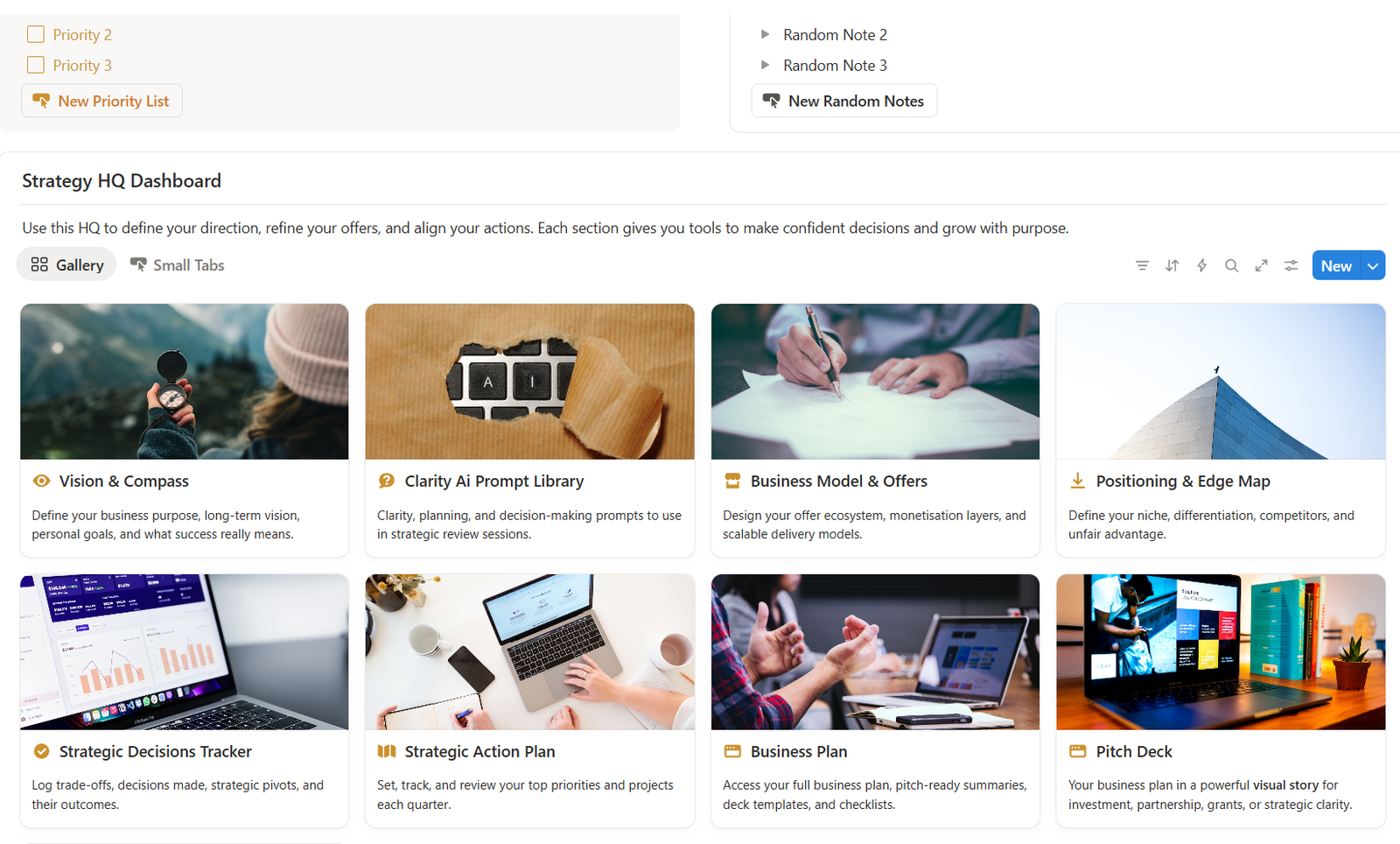
When a system like Clarity Business OS is in place, the day to day experience of work changes. Each week starts with clarity rather than reaction. Priorities are visible and grounded in strategy, not scattered across tools or held in someone’s head. Work is chosen intentionally rather than driven by urgency.
A business operating system shapes:
What gets worked on each week by anchoring tasks to strategic priorities
How priorities are reviewed and adjusted as conditions change
Where business information is stored so it can be reused and trusted
How decisions are documented, creating continuity instead of reinvention
Instead of adding another layer of complexity, the operating system reduces friction. It removes repeated decision making, lowers cognitive load, and creates a shared reference point for how the business operates.
Over time, it becomes the place where work makes sense, context is preserved, and progress feels deliberate rather than chaotic.
For a practical example of how this structure is implemented, see:
Clarity Business OS
Where Clarity Business OS Fits
Clarity Business OS is designed as a practical implementation of a business operating system for modern founders and service based businesses.
It provides a structured environment to hold strategy, projects, workflows, documentation, and review processes in one place. Rather than stitching together disconnected tools, it offers a cohesive system designed for clarity, scale, and future AI integration.

Final Thoughts
A business operating system is not about control. It is about coherence.
As businesses grow more complex, structure becomes essential. Not rigid structure, but thoughtful systems that support clarity, decision making, and sustainable progress.
Tools will change. Technology will evolve. The businesses that thrive will be built on strong operating systems rather than constant effort.
Clarity is not accidental. It is designed.
Get Free Notion Tools + System Tips
Join us for clarity-boosting tools, Notion templates, and simple systems to streamline your digital life.
No spam. Unsubscribe anytime.